It’s a two-part process
- Consumption Period (reading)
- Digestion Period (retention)
- These two stages must always be balanced.
- Everything you consume must be digested in order for you to retain and use it.
- What stays in your brain is more important than what goes into your brain.
Types of Information (P.A.C.E.R.)
- Procedural - A set of instructions or processes followed to achieve a specific outcome. This is the “how” to do something.
- Analogous - Information that is related to something you already have prior knowledge about. Analogy can form without any prior knowledge.
- Example he gives: an avid swimmer is learning about muscle contraction and thinks “the muscle contraction cycle reminds me a lot of a swimming technique I use”.
- Conceptual - Compared to Procedural information (the “how” to do), this is the “what” to do. Science subjects usually fall under conceptual knowledge.
- Evidence - Information that makes conceptual information more concrete. Evidence is often detailed and concrete information
- Reference - All the nitty-gritty, specific information that don’t really change your conceptual understanding.
Digestion Strategies
When consuming material for learning, be thinking about these types, is this material:
A set of instructions or processes to be followed to achieve a specific outcome?
TYPE: Procedural
PROCESS: Practice
- Practice what you read as soon as possible. If you can’t immediately practice what you read:
- Move on to something else.
- Stop consuming information, and wait until you have time to practice it.
- Do not just try to memorize this type of information non-stop without practicing.
Information that is related to something you already have prior knowledge about?
TYPE: Analogous
PROCESS: Critique
- Once an analogy is established, critique it to determine how good the analogy actually is. Ask:
- How are these things related?
- How are they different?
- In what situation does this analogy not make sense anymore?
- Is there a better analogy, or can we modify or extend the current analogy?
Facts and explanations, theories and principles, relationships between concepts, applications of concepts?
TYPE: Conceptual
PROCESS: Mapping
- Conceptual + Procedural = Problem solving and knowledge application
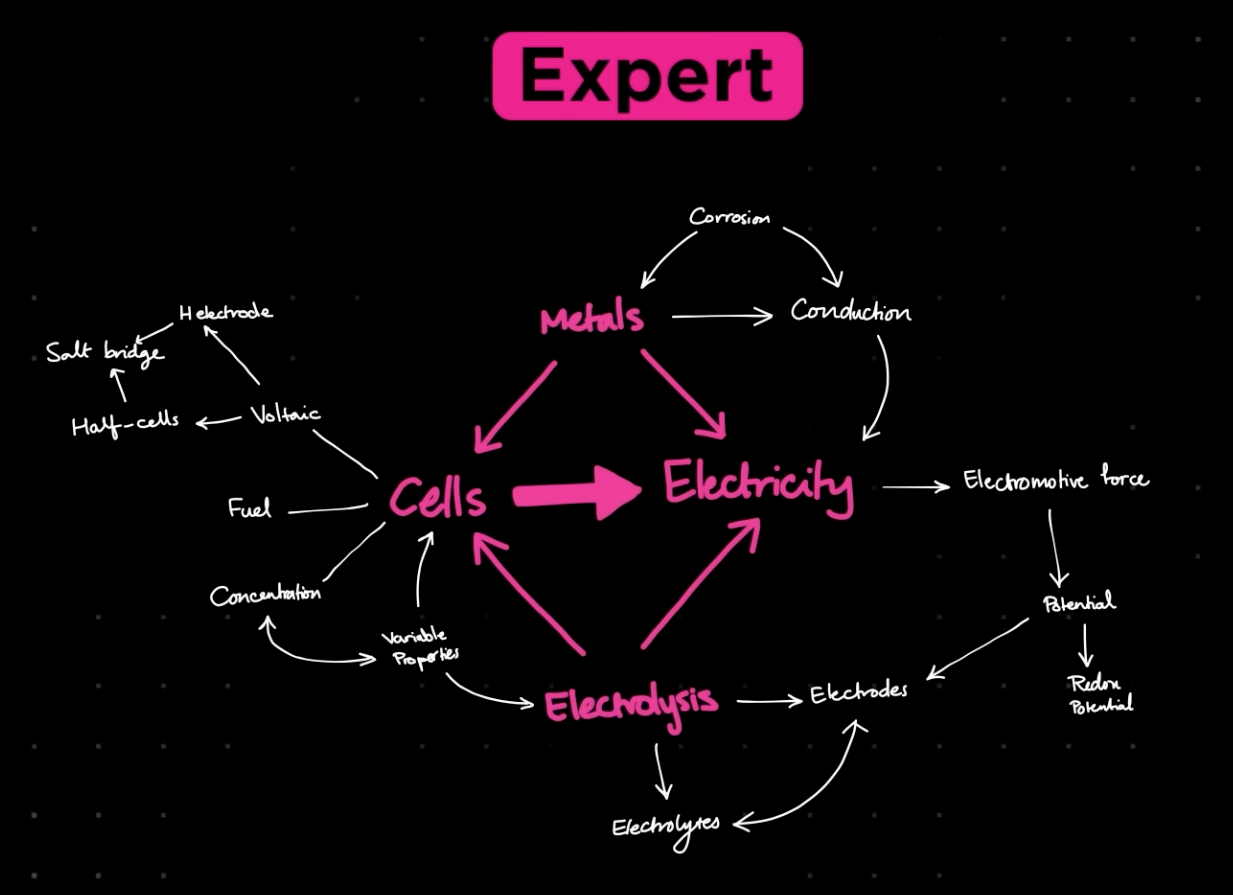
- Non-linear, network based information.
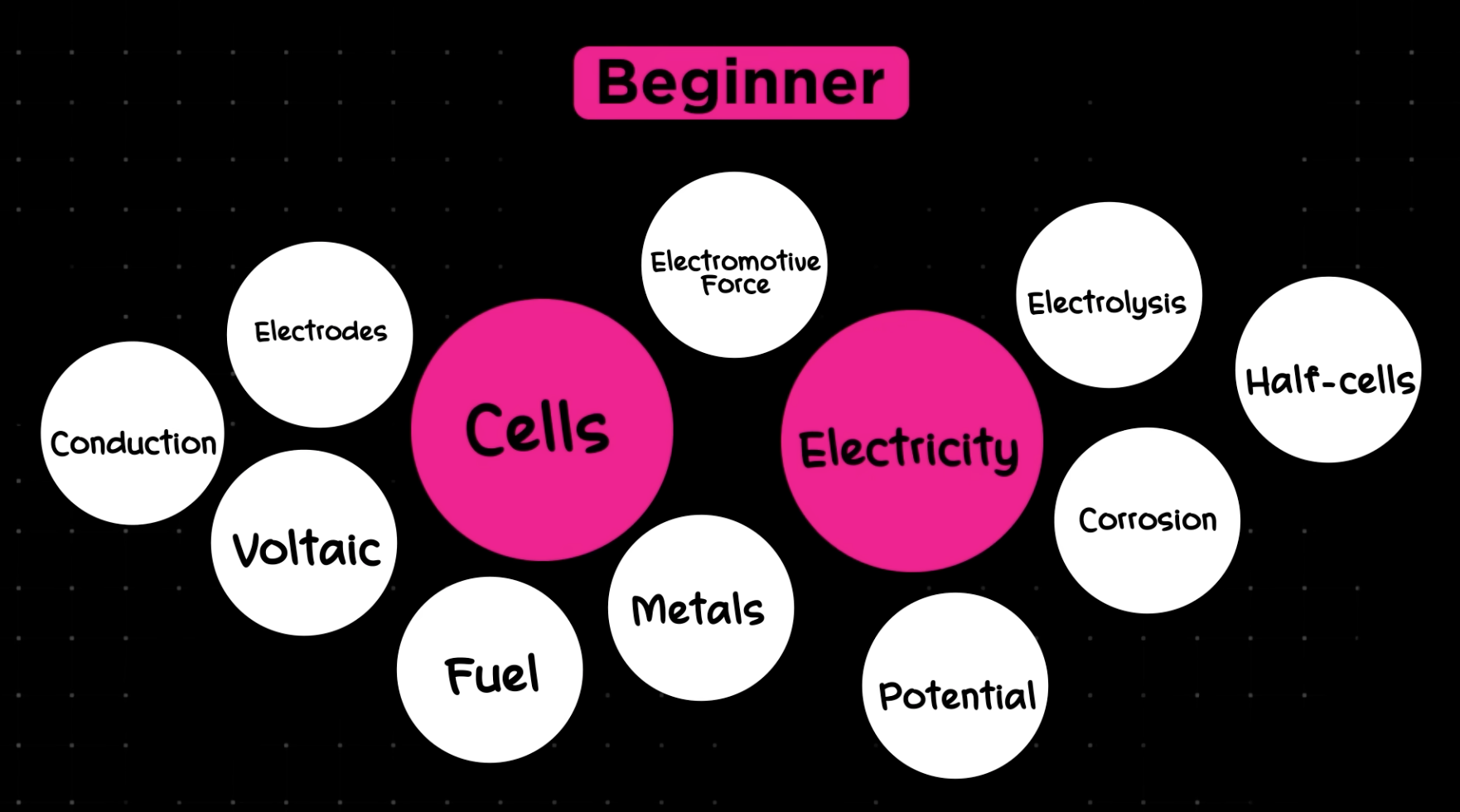
- Purpose is to re-create the network of knowledge that the expert has.
- Mapping forces us to not only think about each fact and concept, but also how they connect to each other to form a bigger picture.
- As you’re reading, start to map the information so you understand it better. Do this as you are reading.
- Conceptual information can be used to create analogies.
Mind map of an expert, interconnected concepts
 Beginner, un-connected concepts
TYPE: Evidence
PROCESS: Store & Rehearse
- Evidence type information can be used as examples to prove a conceptual point.
- Store & Rehearse
- “Store” means that you just collect that information and note it down somewhere.
- “Rehearse” means to ask:
- How to use the information?
- How to apply the information?
- What type of conceptual information is this an example of?
- This type of information should be documented (stored) as soon as it’s identified.
- Do not waste time overly taking notes for Evidence type information because it will come at the cost of the Procedural, Analogous, and Conceptual processes.
TYPE: Reference
PROCESS: Store & Rehearse
- Not particularly important.
- Doesn’t fall under any of the other types of information.
- Information we might need to know later.
- Examples:
- The exact value of a mathematical concept
- A specific gene involved in a particular mutation
- The name of a specific molecule of disease
- A list of attributes used to define a variable for coding.
- Used for direct fact recall, such as when using flashcards combined with spaced repetition active recall strategy. Go through your flashcards regularly to help solidify this information.
- Don’t waste too much time for this type of information.
Active Learning
- Am I trying to make new information simpler to understand?
- Am I grouping the information together?
- Am I thinking about how what I’m learning relates to the big picture?
- Am I recalling things I’ve learned from memory? If the answer to any of these questions is no, try to make it a yes.