Hexagonal Architecture (also known as Ports and Adapters) isolates business logic from external dependencies through well-defined interfaces.
Core Concept
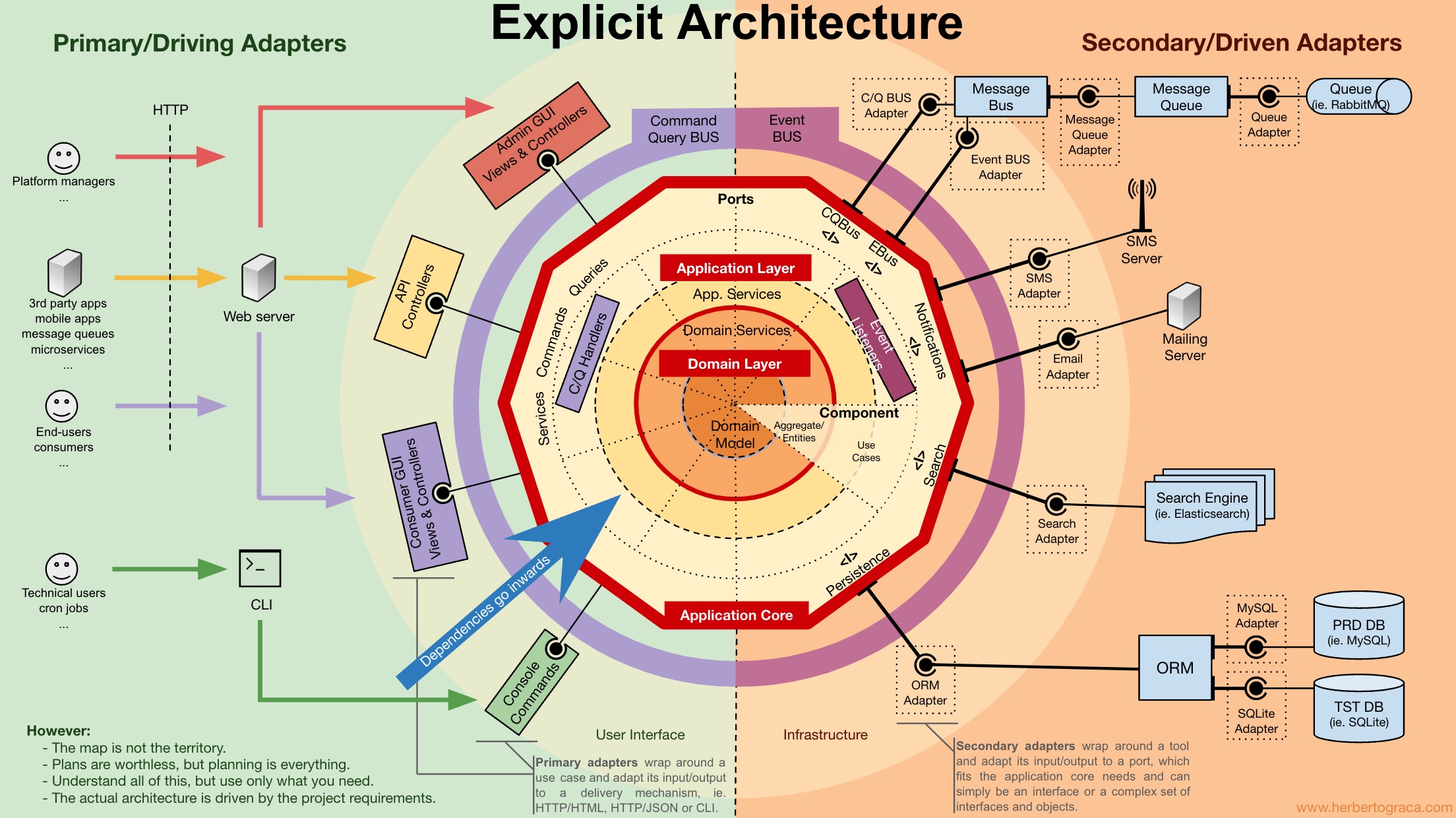
The application core (business logic) is surrounded by adapters that handle communication with external systems. The hexagon shape emphasizes that there’s no inherent “top” or “bottom” - all external systems are treated equally.
Components
Application Core (Inside the Hexagon)
- Contains business logic
- Defines ports (interfaces)
- Independent of external technologies
Ports
- Primary/Driving Ports: Interfaces for driving the application (e.g., use case interfaces)
- Secondary/Driven Ports: Interfaces for things the application needs (e.g., repository interfaces)
Adapters
- Primary/Driving Adapters: Trigger application (e.g., REST controllers, CLI, UI)
- Secondary/Driven Adapters: Implement infrastructure (e.g., database, message queue, external APIs)
Benefits
- Technology Independence: Swap databases, frameworks without changing core
- Testability: Test business logic with mock adapters
- Flexibility: Multiple adapters for same port (e.g., REST and GraphQL APIs)
- Clear Boundaries: Explicit separation of concerns
Example Structure
Application Core
├─ Domain Logic
├─ Ports (Interfaces)
   ├─ Driving: IOrderService
   └─ Driven: IOrderRepository

Adapters
├─ Driving
│  ├─ REST API Controller
│  └─ CLI
└─ Driven
   ├─ PostgreSQL Repository
   └─ Redis Cache
Visual Reference
From Architecture:
Resources
Related Concepts
- Clean Architecture
- Domain Driven Design
- Dependency Inversion Principle