
So I have some good news. I have accepted a job offer, and I start in a little over a week. I am super excited about it - on paper it sounds like a perfect fit for me for a bunch of reasons I won’t go into here. In preparation for starting this new job I’ve been spending a bit of time thinking about what I value most in a team, and there is one thing that in my opinion is a requirement - it is absolutely foundational if a team wants to become high-performing - it’s psychological safety.
What does psychological safety mean to me?
There are lots of ideas that go into psychological safety. I won’t try to capture them all here, but off the top of my head:
- Feeling safe to express what is on your mind, including:
- Safety from being reprimanded for presenting bad news, e.g. shooting the messenger
- Safety to present alternative viewpoints
- Feeling safe to ask questions
- There are no stupid questions
- Knowing that it is okay to not have all the answers, or to say “I don’t know” in response to a question
This last one is pretty key to fostering a culture of psychological safety in the team, let’s explore why.
Three words - “I don’t know”
It is part of the responsibility of a team leader to help create the feeling of psychological safety in the team - and yet, so many leaders fall into the trap of believing that they cannot show any weakness or they will lose respect in the team.
Many first-time leaders feel the pressure to have the answer to every question. Sometimes this is a feeling about saving face, and not wanting to look ill-informed or have zero knowledge. At the same time, a leader can’t know everything. The magic words to repeat are, “I don’t know.” Saying these magic words within a team is key to building psychological safety.
- Pat Kua, Level Up - Issue 201
This is not solely the responsibility of a leader - like so many things in software engineering, it is a team responsibility. However, people in leadership roles are uniquely positioned to have a significant impact on feelings of safety - the people around them (hopefully) respect and even look up to them. Leaders set the tone for the rest of the team, for better or for worse:
Leaders lead by example, and if you appear to have all the answers all the time, team members will never raise their hand for help, staying blocked or making decisions with poorer outcomes.
- Pat Kua, Level Up - Issue 201
A leader’s gotta lead
Of course, a leader has to have some of the answers some of the time, otherwise they aren’t really much of a leader.
…saying “I don’t know” all the time isn’t appropriate either. You should have some core understanding of the area you are leading and made some attempts to gain more understanding. Saying “I don’t know” without effort will make you appear ill-informed or incompetent. But if you share your understanding of the context, explain the gap, ask questions and stay curious, others will have a more profound respect for you by acknowledging your limits and willingness to expand them.
- Pat Kua, Level Up - Issue 201
So it is something that needs to be monitored all the time. Things outside of a leader’s control can happen that have an impact on a team’s psychological safety. Team attrition, public scolding, crunch time - all of these and more can have a negative effect on psychological safety in the team, and we need to be able to tailor our actions to fit the current needs.
Moving away from the default with intention
One thing I’d like to call out here is that it’s not always that a team or an organisation is so intentionally fostering a culture of low psychological safety. I am by no means saying that teams or organisations that don’t already have a culture of psychological safety are *bad. *Low psychological safety is the default - people inherently want to protect themselves and their livelihoods, and will behave accordingly. It is only when it is consistently demonstrated by enough people that vulnerability is not a weakness, that people will feel comfortable to let their guard down a bit…
Safety enables higher performance and autonomy
An organisation that does not foster a culture of psychological safety can never have truly autonomous teams. People need to be given the space to make mistakes (and learn from them), ask questions, and come to decisions for themselves. The alternative is a few people in positions of power making all of the decisions, and when they’re not around, nothing getting done.
Ron Westrum captured three categories of organisational culture; pathological, bureaucratic, and generative; describing some of the key characteristics of each: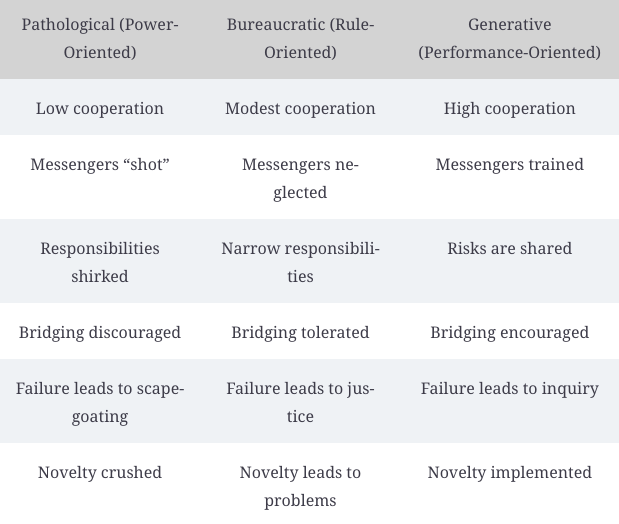 The authors behind Accelerate: Building and Scaling High Performing Technology Organizationswrite about generative culture
…First, a good culture requires trust and cooperation between people across the organization, so it reflects the level of collaboration and trust inside the organization.
Second, better organizational culture can indicate higher quality decision-making. In a team with this type of culture, not only is better information available for making decisions, but those decisions are more easily reversed if they turn out to be wrong because the team is more likely to be open and transparent rather than closed and hierarchical.
Finally, teams with these cultural norms are likely to do a better job with their people, since problems are more rapidly discovered and addressed.
And so as I look towards the future and this new role, one of the first things I will be looking for and looking to encourage is psychological safety. I’m going to be asking lots of questions, and probably saying “I don’t know yet, let me get back to you” a whole lot.